Digital Productivity, Online planners, Planners
Daily Routine Template: Free Downloads & Habit Tracking
Mar
Okay so I just spent the last three weeks testing basically every free daily routine template I could find and here’s what actually works in 2025, because honestly most of them are either too complicated or weirdly minimalist in that unhelpful way.
The Templates That Don’t Suck
I’m gonna start with the Google Sheets template from Notion because wait, no, that’s confusing. Let me back up. So there’s this free template hub called Template.net that has like 47 different daily routine templates and I thought it would be overwhelming but actually the “Time-Blocked Daily Schedule” one is ridiculously practical. You can literally just download it, plug in your actual wake-up time, and it auto-calculates everything in 30-minute blocks.
The thing nobody tells you about time-blocking templates though is that you gotta leave buffer time or you’ll lose your mind by 2pm. I learned this the hard way when my dog decided to have a vet emergency right during my “deep work block” and suddenly my entire template was useless.
Notion Templates Are Having A Moment
The Notion daily routine templates are everywhere right now and honestly some of them are actually good. The one I keep coming back to is called “Daily Dashboard” by a creator named Marie Poulin, it’s free in the Notion template gallery. What makes it work is the habit tracker is literally embedded right next to your schedule so you’re not switching between apps or pages.
Here’s what it tracks without making you feel like you need a PhD:
- Morning routine checklist (you customize what goes here)
- Time blocks with actual tasks, not just “work” or “exercise”
- Water intake tracker that’s just circles you click
- Habit streak counter that shows your last 7 days
- Evening reflection (just three prompts, not a whole journal)
I’ve been using it since January and the only annoying thing is that Notion mobile can be glitchy when you’re trying to check off habits quickly. Like if you’re at the gym and wanna mark that you worked out, sometimes it takes forever to load.
Printable PDFs That Actually Print Correctly
Oh and another thing, if you’re a paper person (which I am like 60% of the time), the Passion Planner website has this free PDF worksheet called the Daily Roadmap. It’s one page, prints perfectly on regular printer paper, and has this section at the top for your “focus” which I thought was cheesy but it actually helps.
The layout is basically:
- Top third: your main goal for the day plus three priorities
- Middle section: hourly time blocks from 6am to 10pm
- Bottom: habit tracker boxes and a gratitude line
- Side margin: random notes section that’s actually big enough to use
I print like 10 of these at a time and keep them in a clipboard. My coffee spilled on one last week and it was fine, just kept using it. That’s the beauty of free templates, you don’t feel precious about them.
Habit Tracking That Doesn’t Make You Feel Like Garbage
Okay so funny story, I tried using Habitica (that gamified habit tracker app) and it made me feel worse because I kept “losing HP” when I didn’t floss. Like I don’t need my habits to be a video game where I’m constantly dying.
The better approach I found is the “Don’t Break The Chain” method but in template form. There’s a free Excel template on Vertex42 (just google “Vertex42 habit tracker”) that’s literally just a calendar grid where you mark an X when you do the thing. Super simple. No streaks counter that makes you feel terrible when you miss a day, just visual dots that you can see patterns in.
I track these habits and nothing more:
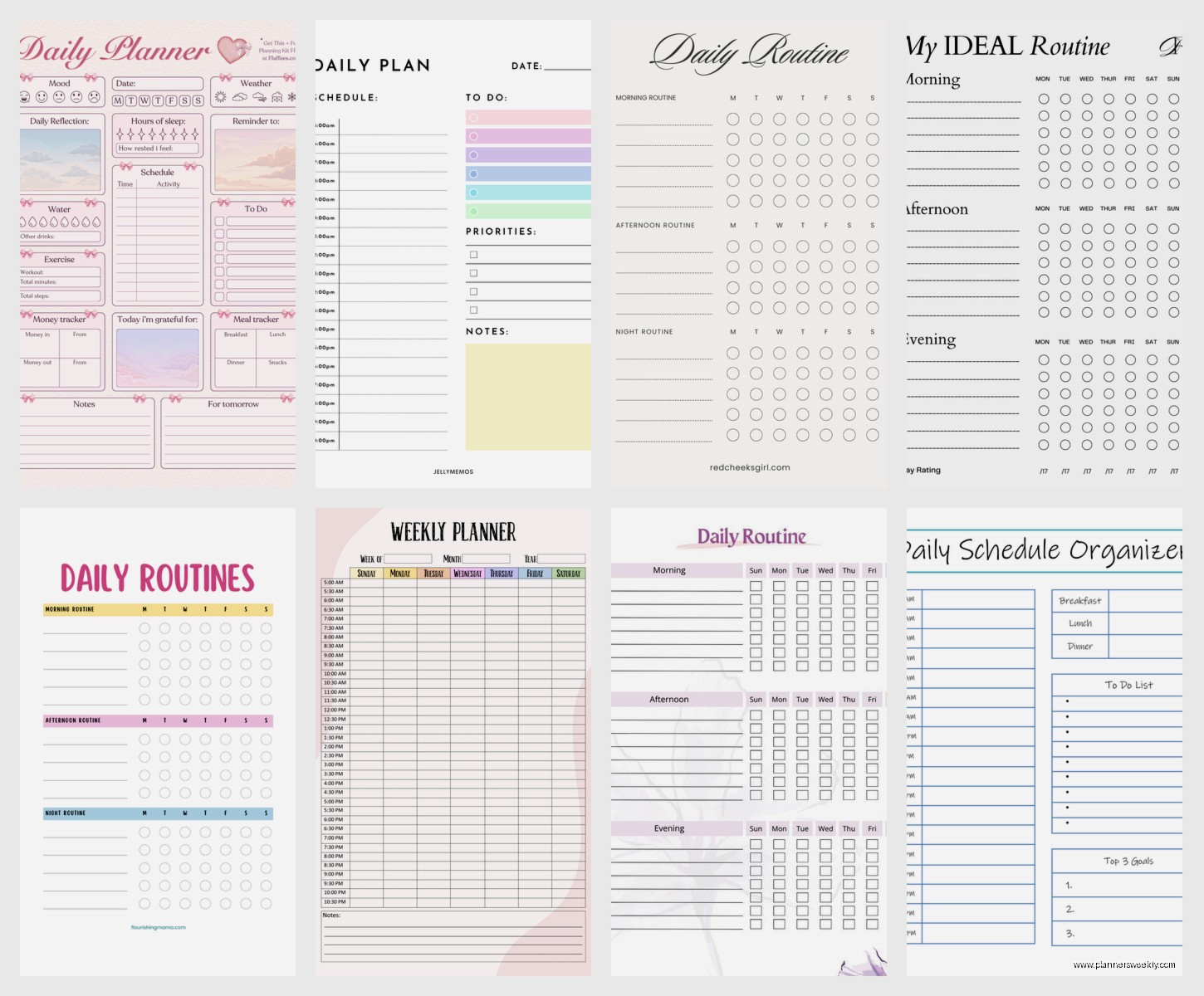
- Took vitamins
- Moved for 20+ minutes
- Drank 4 glasses of water
- No phone first hour after waking
- Read before bed instead of scrolling
That’s it. Five things. Everyone who tries to track like 15 habits burns out by February.
The Google Sheets Template I Actually Use Daily
Wait I forgot to mention the one I use most consistently. It’s called “The Daily Spreadsheet” and you can find it by searching that exact phrase plus “free template” and it’s the one by Better Sheets. It looks kinda ugly at first, very basic formatting, but that’s why it works.
It has tabs for each day of the week and you fill out:
- What time you woke up (it calculates if you’re consistent)
- Your three must-do tasks (not 10, just three)
- Appointments or time-specific stuff
- Habit checkboxes (you decide which habits)
- Energy level at three points in the day (morning, afternoon, evening)
- One-sentence summary of the day
The energy tracking thing seemed dumb to me but after two weeks I realized I always crash at 2:30pm and now I schedule easier tasks then instead of trying to do hard thinking work. Game changer.
Apps With Free Templates Built In
This is gonna sound weird but Google Calendar has routine templates now and nobody talks about it. If you go to the web version, there’s a “Routine” option when you create an event. You can build a morning routine template that repeats daily and it’ll show up as one block on your calendar.
I made mine show “Morning Routine: 6:00-7:30am” and when I click it, the description has my actual checklist:
- Drink water
- 10 min stretch
- Shower
- Breakfast while reading
- Review today’s calendar
- One small task before email
It’s free, syncs everywhere, and you’re probably already using Google Calendar anyway so it’s not another app to check.
The Printable I Recommend To Clients
My client canceled last week so I spent an hour comparing the printable templates from different productivity bloggers and the one from Minimal Notion Planner website (ironic name since it’s a PDF) is genuinely the best designed. It’s called “Structured Daily Planner” and it’s a half-page size which is perfect.
You print two per page, cut them in half, and stick them in a small notebook. The layout has your schedule on the left side and habits plus notes on the right. There’s also this small box at the very top for “one thing that would make today great” which sounds motivational-poster-ish but it actually helps you prioritize.
The habit tracking section has space for 7 habits with little circles, and here’s the smart part, the circles are big enough that you can put a dot for “kinda did it” or fill it completely for “totally did it” instead of just binary yes/no.
Digital Templates For Your Phone
If you’re doing everything on your phone (which honestly makes sense for habit tracking), the free version of Habitify is pretty solid. You get to track up to 5 habits and it has a widget for your home screen.
I have mine set up to track:
- Morning pages (just 5 min of writing)
- Workout
- Vegetables at lunch
- Evening walk
- Lights out by 10:30
The widget shows little dots that turn green when you check them off and it’s satisfying without being over-gamified. The premium version has unlimited habits but honestly if you need to track more than 5 things you’re probably overcomplicating it.
Combining Schedule Templates With Habit Tracking
Here’s what actually works after testing this for three weeks straight: you need your schedule and your habits in the same place or you’ll forget one of them.
The template I built for myself (and yeah I’ll share it, it’s just a Google Doc) has the day split into four blocks:
- Morning block (wake up to lunch)
- Afternoon block (lunch to 5pm)
- Evening block (5pm to dinner)
- Night block (dinner to sleep)
Under each block there’s space to write 1-2 specific things you’ll do, plus checkboxes for habits that happen during that time. So my morning block has checkboxes for “took vitamins” and “exercised” right there, not on a separate tracker.
This sounds so simple but it’s the only system where I consistently track habits for more than a week because I’m looking at the template anyway to see what I’m supposed to be doing.
The Weekly Review Template That Makes Daily Templates Actually Work
Oh and you gotta have a weekly template that reviews your daily stuff or it’s just busywork. I use a Notion template called “Weekly Reflection” that’s free and it asks:
- Which habits did you hit 5+ times this week?
- What time blocks consistently didn’t happen?
- Energy patterns you noticed
- One thing to change next week
Takes maybe 10 minutes on Sunday evening and it’s the difference between just filling out templates versus actually improving your routine. I was watching The Last of Us while doing mine last Sunday and still got useful insights, so it doesn’t require like deep concentration.
Templates To Avoid
Real quick, some templates are just bad and waste your time:
The super detailed ones that have you planning in 15-minute increments are exhausting. Nobody sticks with those unless you’re a surgeon or something.
Anything that makes you rate your mood on a scale of 1-10 multiple times per day. Too much tracking becomes anxious-making.
Templates with inspirational quotes at the top. I don’t need Tony Robbins telling me about morning routines, I need boxes to check.
The “miracle morning” style templates that assume you have 2 hours before work. Most of us have like 45 minutes if we’re lucky.
How To Actually Stick With A Template
This is gonna sound obvious but pick ONE template and use it for at least two weeks before switching. I know it’s tempting to try a new one every few days (I did this for the first week of testing) but you learn nothing that way.
Start with tracking just 3 habits max. You can always add more later but if you start with 10 you’ll quit by Thursday.
Put the template somewhere you’ll actually see it. I have my Notion dashboard as my browser homepage and my printable template literally taped to my desk. If it’s buried in a folder you won’t use it.
Don’t fill it out perfectly. Some days I just check the habits and skip the schedule part. Some days I only fill out morning and ignore the rest. That’s fine. The template is a tool, not a test you pass or fail.
The best template is the one you’ll actually open tomorrow, not the prettiest one or the most comprehensive one. I’ve been using that basic Google Sheets template for actual daily tracking and the Notion one for planning, and that combo works because one is fast (Sheets) and one is pleasant to look at (Notion).
Print a few different templates this week and just see which one you naturally reach for. That’s your answer.